How to Price AI Services for Local Businesses (Retainer Guide)
How to price AI services for local businesses on value, not hours: a simple ROI formula, three retainer tiers, setup fees and how to present the numbers.
Price AI services for local businesses on the value you protect or recover for them each month, not on your hours. The simplest way: estimate what slow replies and forgotten follow-ups cost the business, show what an AI assistant could recover, and set a flat monthly retainer that is a small fraction of that number. This guide shows the formula, three tier structures and how to present them so the owner says yes.
It is written for people starting a local AI agency. If you’re earlier than that, start with our 30-day plan to start a local AI agency.
Why hourly pricing fails for AI services
The whole point of AI services is that work happens without anyone’s hours. If you charge for time, the better your system works, the less you earn. Owners also struggle to judge hours: they don’t know whether five hours is a lot.
What owners understand is their own numbers: how many enquiries come in, how many become jobs, and what a job is worth. Price in those terms and the conversation moves from “how much does this cost?” to “how much does this save?”.
The value formula
You need five numbers from the business. Most owners can give rough answers in a five-minute conversation:
- Enquiries a month (calls, forms, messages)
- Share answered late or missed (after hours, weekends, busy days)
- Close rate when answered quickly
- Average job value
- How many of the missed enquiries a fast reply would recover (be conservative: a third or less)
Monthly value lost = enquiries × share missed × close rate × average job. Monthly value recovered = value lost × the conservative recovery share.
For a dental practice with 120 enquiries a month, 35% answered late, a 30% close rate and a $1,200 average treatment, the value lost is about $15,000 a month. Recovering even a third of that is several thousand dollars a month: a figure that makes a retainer of a few hundred dollars look small.
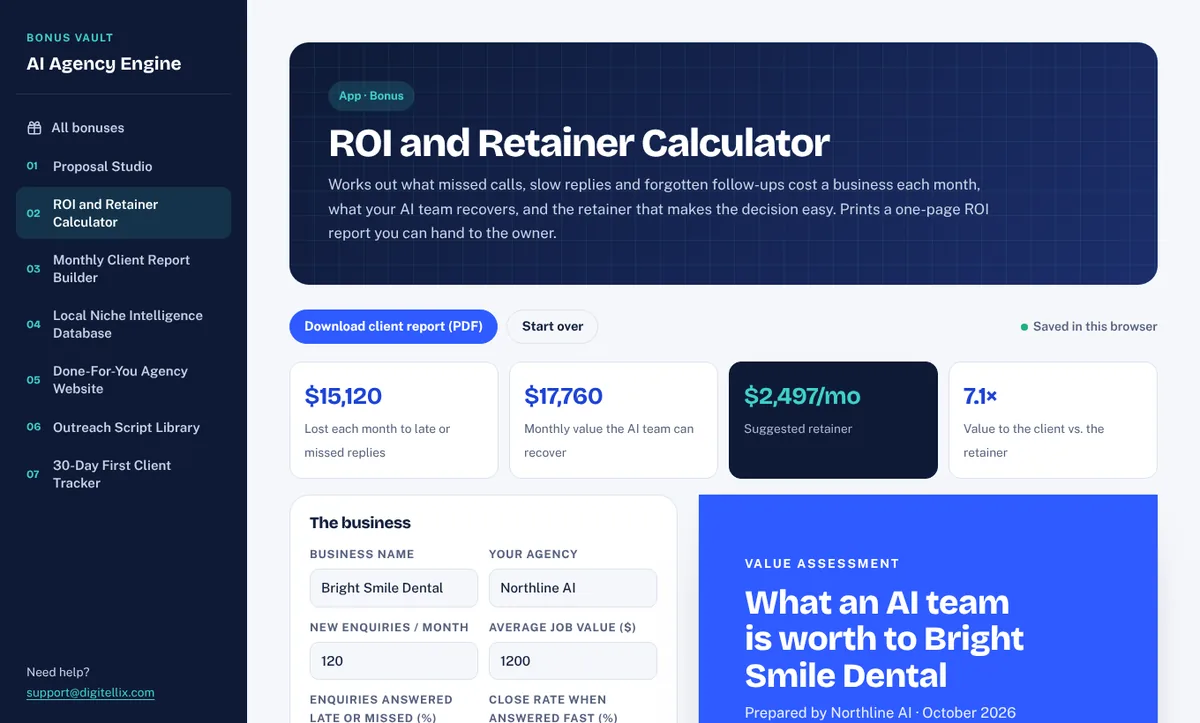
The ROI and Retainer Calculator from our AI Agency Engine bonus vault runs this formula live and prints a one-page report for the owner. The example uses illustrative numbers.
Two rules keep this honest. Use the owner’s numbers, not yours. And always show the conservative case: if the deal only works on optimistic assumptions, it isn’t a good deal.
Want the numbers done for you? Our free local SEO pricing calculator applies this formula, suggests a fee and three package prices, and shows your margin.
Setting the retainer
A simple anchor: price the retainer at 10% to 20% of the monthly value recovered in the conservative case. The owner keeps most of the gain, which is what makes the decision easy.
Round to a clean number and check it against your floor: the minimum you need per client to make the work worthwhile. If the formula gives a number below your floor, the business is too small for that service, or you need to bundle more into the offer.
Three tiers that sell themselves
Offer three options. Most owners pick the middle one, so make the middle one the one you want to sell.
| Tier | What it includes | Typical shape |
|---|---|---|
| Starter | One assistant for one job (for example, instant replies to new enquiries) | Lowest monthly fee, simplest to deliver |
| Growth (recommended) | Instant replies plus follow-ups and review requests, monthly report | Two to three times Starter |
| Premium | Everything in Growth plus custom assistants and priority changes | Two times Growth |
Name the tiers after outcomes rather than features when you can (“Never miss an enquiry”, “Fill the calendar”), and put the recommended tier in the middle with a short reason.
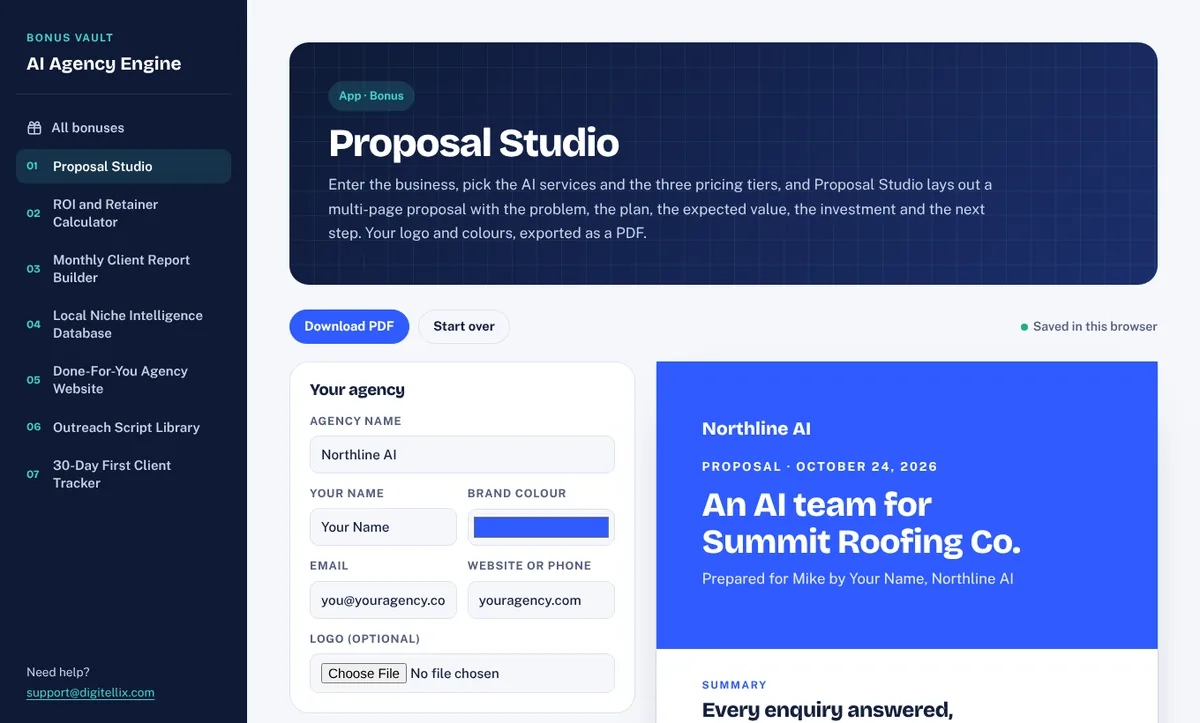
Proposal Studio builds the three-option proposal as a branded multi-page PDF, with the recommended tier highlighted.
Setup fees, pilots and contract length
Setup fee. Charging for the first month’s research and configuration is normal. Keep it modest, and explain what it covers.
Pilot. For hesitant owners, offer a 30-day pilot measured on two numbers they care about, such as reply time and booked calls. Agree the numbers before you start. A pilot moves risk from their side to yours, which closes deals that would otherwise stall.
Contract length. Month-to-month after the pilot keeps you honest and makes the yes easier. If you want longer terms, trade them for something: a waived setup fee or a lower monthly rate.
Presenting the price
Show the numbers in this order:
- Their problem in their words. “You told me about 40 enquiries a month come in after hours.”
- What it costs them. The conservative monthly value lost.
- What the service recovers. Again, the conservative case.
- The three options. Recommended tier in the middle.
- The next step. Start date, setup and what they need to do.
Leave a one-page summary behind. Owners often decide after the call, with a partner or an accountant, and the page sells for you when you’re not there.
Raising prices later
Your first clients pay for your learning. Once you have two or three monthly reports showing results, raise prices for new clients and add services for existing ones. A monthly report with plain numbers (replies sent, follow-ups made, reviews requested, time saved) is the best tool for keeping clients and growing the account.
Handling “that’s too expensive”
Price objections are usually value objections. Go back to the numbers rather than lowering the price:
- Recheck the inputs together. “You said about 40 enquiries a month come in after hours. Is that about right?” If their real numbers are lower, the honest answer may be a smaller tier.
- Shrink the scope, not the price. Offer Starter instead of Growth, or a single assistant, so the price still reflects the value.
- Offer the pilot. Thirty days, measured on numbers you agreed in advance.
Discounting the same service teaches the owner your first number wasn’t real, and it makes every later price increase harder.
A note on honesty
Every number in your proposal should come from the owner or be clearly marked as an estimate. Never promise revenue; promise what you control, such as reply times, follow-ups sent and hours saved. Owners trust a modest, sourced estimate far more than a big guess, and that trust is what keeps them paying month after month.
Common pricing mistakes
- Pricing on the tool’s cost. The owner isn’t paying for software; they’re paying for results.
- Too many options. Three is the maximum. More choices slow decisions.
- Discounting before you’re asked. Offer a pilot instead of a discount.
- No monthly report. Without one, the owner forgets what they’re paying for.
Where AI Agency Engine fits
You can apply everything here with any toolset. AI Agency Engine is built for this exact model: paste a business’s website, get a custom AI team with a value estimate and a pitch email ready. It opens on Tuesday, November 3 at 11:00 am ET, with a free early-bird webinar at 10:00 am ET.
If you buy through Digitellix, the calculator and proposal studio shown above are part of the AI Agency Engine bonus pack, with a niche database, outreach scripts, a client report builder and a 30-day first-client tracker. Our guide to cold emails that get replies from local businesses covers the step before the pricing call.
Questions
Should I charge local businesses by the hour for AI services?
No. Hourly pricing punishes you for automating. Price on the monthly value the service protects or recovers for the business, and charge a flat monthly retainer.
What is a reasonable starting retainer for a first client?
Many new agencies start between a few hundred and around a thousand dollars a month for one clearly measured service, then raise prices as they add services and results.
Should I charge a setup fee?
A modest setup fee is common and fair because the first month includes research and configuration. Some agencies waive it in exchange for a longer commitment or a pilot.