How to Write a Cold Email to a Local Business That Gets Replies
A proven structure for cold emails to local business owners: one specific observation, one clear offer, one small ask, plus follow-ups and sending rules.
A cold email to a local business owner gets replies when it does three things in under 120 words: it proves you looked at their business (one specific observation), it names one result you can deliver, and it asks for something small, like a 15-minute call. Everything else is decoration. This guide gives you the structure, three examples, the follow-up sequence and the sending rules that keep you out of spam folders.
It is the step before the pricing conversation, which we cover in how to price AI services for local businesses.
Why most cold emails to owners fail
Owners of roofing companies, dental practices and cleaning businesses get pitched constantly. Most pitches fail for the same reasons:
- They’re about the sender. “We are a leading AI agency…” The owner doesn’t care yet.
- They’re generic. Nothing in the email proves the sender looked at the business.
- They ask too much. “Can we book an hour to walk you through our platform?”
- They’re long. Owners read email on a phone between jobs.
Fix those four things and your reply rate changes completely.
The structure: observation, offer, ask
1. The observation (one or two sentences). Something specific and true about their business that suggests a problem you can solve. Spend two minutes on their website or reviews to find it:
- “Your contact form says replies can take up to 24 hours.”
- “Three of your recent Google reviews mention it was hard to get through on the phone.”
- “Your site doesn’t mention weekend availability, but your competitors’ do.”
2. The offer (one or two sentences). One result, in their language, not a list of features. “I set up AI assistants that answer every enquiry within a minute, day or night, in your voice. Nothing goes out that you haven’t approved.”
3. The ask (one sentence). Small and specific. “Worth a 15-minute call this week to see what it would catch for you?”
Then your name, your business name and your phone number.
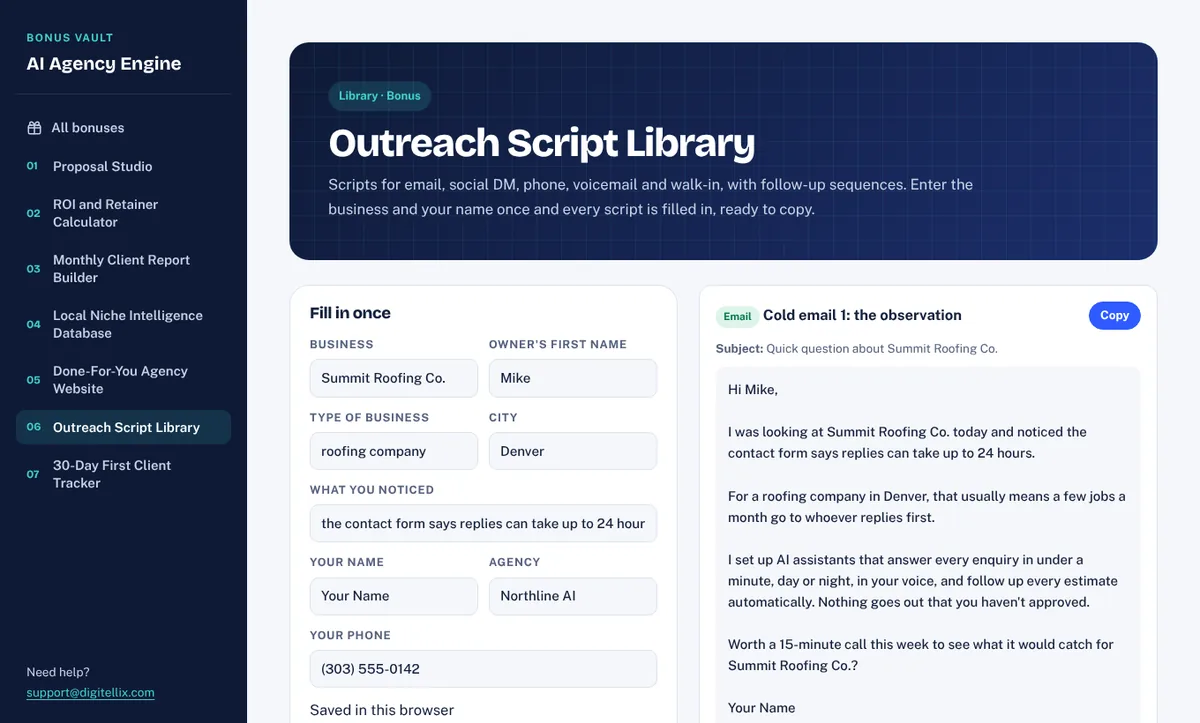
The Outreach Script Library from our AI Agency Engine bonus vault fills these scripts with the business name, city and your observation, ready to copy.
Three examples
Roofing company
Subject: Quick question about Summit Roofing
Hi Mike,
I was looking at Summit Roofing today and noticed the contact form says replies can take up to 24 hours. For a roofer in Denver after a storm, that usually means a few jobs a month go to whoever replies first.
I set up AI assistants that answer every enquiry in under a minute and follow up on every estimate automatically. Nothing goes out that you haven’t approved.
Worth a 15-minute call this week to see what it would catch for you?
Dental practice
Subject: After-hours enquiries at Bright Smile
Hi Dr. Lee,
I noticed Bright Smile’s booking page only takes requests during office hours, and a couple of recent reviews mention waiting for a call back.
I help practices reply to every new-patient enquiry within a minute, including evenings and weekends, and send recall reminders automatically.
Could I show you how it would work for Bright Smile in a 15-minute call?
Cleaning company
Subject: Your quote requests
Hi Sarah,
Your site asks people to call for a quote, but there’s no way to request one after 6 pm. Most people looking for cleaners search in the evening.
I set up an assistant that answers quote requests instantly, asks the right questions and books the walkthrough on your calendar.
Open to a quick call to see if it fits?
Subject lines
Plain beats clever. The best subject lines look like a normal email from a person:
- “Quick question about [Business]”
- “[Business]‘s contact form”
- “After-hours enquiries at [Business]”
Avoid anything that looks like marketing: exclamation marks, all caps, “free”, “guaranteed”, emojis.
The follow-up sequence
Most replies come from follow-ups. Send two or three, each adding something new:
- Day 3: a short bump with one extra detail. “One more thing I noticed: your Google profile doesn’t list weekend hours.”
- Day 7: a useful resource. A one-page example of what the assistant would reply to a typical enquiry for their business.
- Day 14: a polite close. “I’ll stop here so I don’t clutter your inbox. If after-hours enquiries ever become a priority, just reply to this email.”
The final note often gets the most replies, because it removes pressure.
Handling the replies
Replies come in three kinds, and each has a simple next step:
- “Interested, tell me more.” Don’t send a brochure. Propose two specific times for a 15-minute call, and bring the numbers from your observation.
- “How much does it cost?” Give a range and anchor it to their numbers: “Most practices like yours start at a few hundred a month, which is usually less than one missed patient.” Then offer the call.
- “Not now.” Thank them, ask if you can check back in three months, and put the date in your tracker. Many of your future clients start as a polite “not now”.
Reply within the hour if you can. The speed of your reply is itself a demonstration of the service you’re selling.
Sending rules that protect your domain
- Use a separate domain for outreach (for example, a variant of your main domain) so your main email reputation stays safe.
- Warm it up. Start with 10 to 20 emails a day and increase slowly over weeks.
- Send from a real person’s name, with a real signature and your business address.
- Plain text, no tracking pixels at first. Images and heavy tracking hurt deliverability.
- Always include a way to opt out, and honour it immediately.
- Check the law where you send. US business email falls under CAN-SPAM; the UK, EU and Canada have stricter consent rules.
Tracking your outreach
Keep a simple pipeline: contacted, replied, call booked, proposal sent, won. Ten emails a day, five days a week, is 200 a month. Even modest reply and close rates turn that into a steady flow of calls, and the pipeline shows you which step needs work.
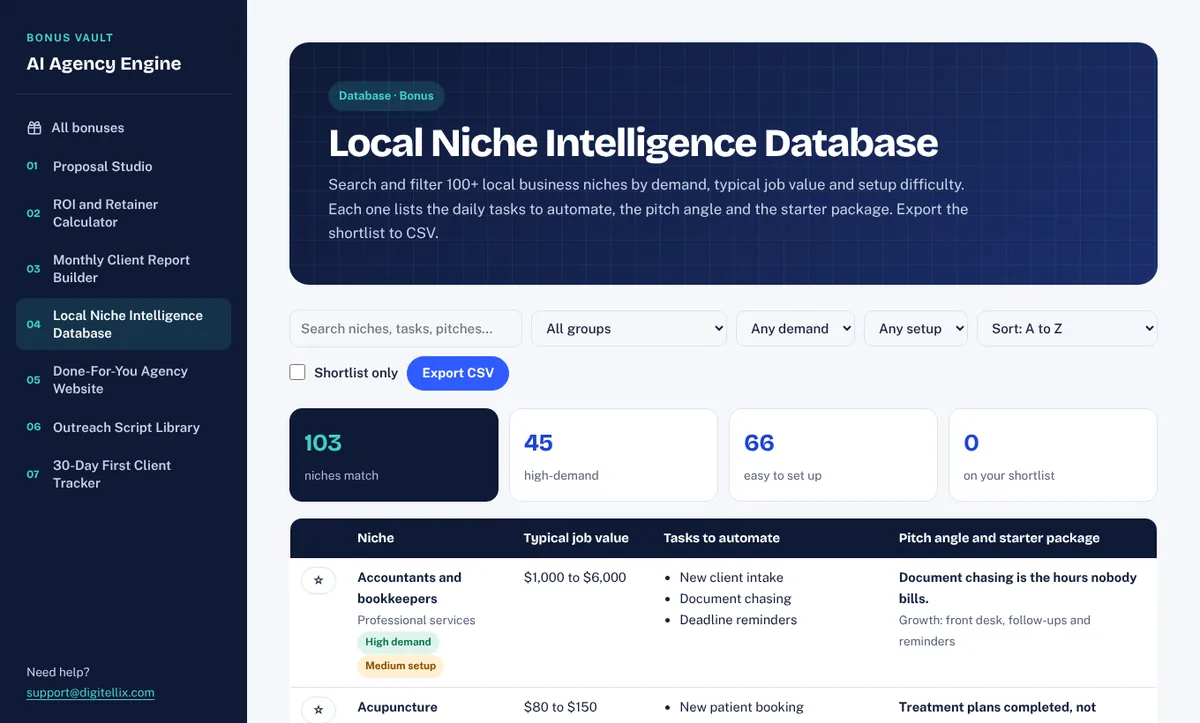
The Niche Intelligence Database helps you choose who to email first: 103 local niches with typical job values, tasks to automate and pitch angles.
A weekly rhythm that works
Research on Monday, send on Tuesday and Thursday, follow up on Wednesday, and book calls on Friday. Splitting research from sending keeps quality high: you write better observations in a focused research block than in between emails. Review your numbers every Friday and change one thing at a time, such as the subject line or the ask, so you know what made the difference.
Where AI Agency Engine fits
Finding the observation is the slow part of cold outreach. AI Agency Engine speeds it up: paste a local business’s website and it builds a custom AI team for that business, with a value estimate and a pitch email drafted for you to review. It opens on Tuesday, November 3 at 11:00 am ET.
Buy it through Digitellix and the outreach library, niche database and pipeline tracker shown here come with the AI Agency Engine bonus pack.
Questions
How long should a cold email to a local business be?
Short enough to read on a phone in 20 seconds, usually 60 to 120 words. Owners read email between jobs; anything longer gets saved for later and forgotten.
How many follow-ups should I send?
Two or three, spaced a few days apart, each adding something new. Stop after the third; a polite final note often gets the most replies.
Is cold emailing local businesses legal?
In the US, business cold email is allowed under CAN-SPAM if you use accurate sender details, an honest subject line, a physical address and a working way to opt out. Other countries have stricter rules, so check yours.